Kiss Me, Deadly
by Edward Gallafent
Starts by going over the opening scene:
- The woman running down the side of a country road at night
- Avoided by 2 cars
- She forces the 3rd car to either stop or run her over, he ends up off the carriageway
- As she approaches the car, heaving and sobbing, the driver (Mike Hammer) says the opening line “You almost wrecked my car… Well?” then “Get in” as he opens the door for her.
- The radio, already on, states the song ‘Rather Have the Blues’ by Nat King Cole is playing next; which plays while the woman is still sobbing and trying to reclaim her breath
- Credits roll in top to bottom of the screen over the background of the couple driving.
- This way the reader has to read them unconventionally, from the bottom upwards
- Which has the effects of making it difficult and disorientating
- Throughout the credits we still hear Nat King Cole and the girls labored breathing
- Darkness, a moody song, a girl in trouble, and a striking visual style – not the style Gallafent wishes to explore
Main Point
- Main wish – to consider how, by mid-1950s, the concerns of the private-eye film noir – which is to say:
- the skills of the hero,
- the pleasures of watching him,
- and the quality of his relations to women
- Have shifted away from the earlier versions of Raymond Chandler or Dashiell Hammett texts
Beginning
- At first the differences don't seem very obvious
- After the credit sequence, the events show the uneasiness of the couple:
- Christina Bailey is naked beneath the trench coat, which she stole in order to escape her unidentified tormentors
- At the police roadblock - she nestles close to Hammer, who claims that she is his wife in order to pass
- After the pass they go to a gas station to get the car check out after it spins off the road - the attendant assumes that they pulled into the bushes to make love
- Hammer's coolness doesn't contradict this - it establishes his status in a familiar way as the hard-boiled private eye:
- The man who sees a lot of beautiful women
- Whose strength is expressed by his ability to resist their seduction
- OR at least to resist until he has identified the good and the corrupt
- One point of the narrative - the dramatic choice between women
- Christina criticizes her rescuer:
- Speaks generally - identifying him as a type of man whose one lasting love is himself - his car, his clothes, his physical fitness - all of which are more important to him than any ability to 'give in a relationship'
- The exciting rescue, and the sexual frisson that goes with it, are complicated by her awareness of the inadequacy of her potential partner
- Summed up in her rhetorical irony: 'And what does woman need to complete her - why, man, of course, wonderful man'
- For the terrorized woman, the self-absorbed Hammer is less than satisfactory, but facing the likelihood of her own death, he is all she has got
Understanding the Problems of Filming Spillane
- The opening action is directly from the novel of same title, but Christina's critique of Hammer's narcissism is introduced by Aldrich and his scriptwriter A.I. Bezzerides
- Background of understanding is to look briefly at Spillane's writing and its contemporary reception
- 24 million copies of Spillane novels were in print in June 1954
- Massive success begins with I, the Jury (1947), One Lonely Night (1951), The Long Wait (1951) and Kiss Me, Deadly (1953)
- Only The Long Wait doesn't feature private eye Mike Hammer as the central character
- Popularity of novels and of Hammer led to several films made by Parklane Pictures and released through United Artists: I, the Jury (Harry Essex, 1953), The Long Wait (Victor Seville, 1951) and Kiss Me, Deadly (Aldrich, 1955)
Mike Hammer
pg 241
- Right-wing vigilante, a war veteran impatient with the process of law and suspicious about corruption in high, and specifically governmental, circles
- novels are narratives about revenge and the ability of one man to destroy a corrupt organization
- Each organization is seem as specifically threatening Hammer and those under his protection, but also more generally as undermining American democracy
- Novels reflect the paranoia of their witch-hunting times:
- Kiss Me, Deadly - Mafia Organization
- One Lonely Night - Communist Party
- Most striking about the novel compared to , say, Chandler is the interest in sadism; destruction of the evil or guilty men enacted by Hammer is presented in terms of the graphic detail of the effects of his violence on these 'soft, pulpy people'
McCarthy and Pornographic Content
- Not new concepts
- Was current in the early '50s - part of wider anxiety about pulp fiction and elements of popular culture such as horror comics, which were the subject of investigation by a Congressional concern
- November 1954, Christopher La Farge's piece for the Saturday Review, 'Mickey Spillane and his Bloody Hammer', explicitly made the connection between 'Hammerism and McCarthyism and expressed 'the disgust of all truly liberal minds' at both
Robert Aldrich's Treatment
- According to the director's own accounts, and some critical discussions of the film - Aldrich took it as an opportunity to express his disgust for Hammer and the politics of Spillaine
- In interview with Francois Truffaut (Cahiers du Cinema, November 1956), he argued that Spillane was 'anti-democratic'
- We should look at his comments over time
- 1956 - 'I regret having accepted the job of making Kiss Me, Deadly. Two horrible films had already been made pf Spillane series, and I should have refused.'
- Twelve years later (Sight & Sound, Winter 1968/69) - 'I was very proud of the film,' and in answer to next question (on his debt to Spillane's novels) claimed -inaccurately- 'The book had nothing. We just took the title and threw the rest away.'
- Robin Wood's description of the critique of the hero as 'devastating and uncompromised' (CineAction 21/22, Summer/Fall 1990)
- 1956 Aldrich's honesty was disarming- '...when I asked my American friends to tell me whether they felt my disgust for that whole mess, they said that between the fights and the kidding scenes they hadn't noticed anything of the sort'
The Problem
- To film a Spillane novel and attempt to be faithful to the effects evoked in the text would have been very difficult in 1955
- If it had been possible to present the smashing of faces, the fascination with female nudity recurrent in the novels would have been impossible to present on the screen under prevailing censorship regulations
- Unsurprising that a liberal director wanted to make a film that appeared critical of author and hero
- I would argue that the figure of Hammer created by Aldrich and Bezzerides is actually quite unlike the figure in the novels and owes a lot to their vision of the role of the film noir private eye in the mid-fifties
- They created a different model of the hero and then offer a critique of that figure, rather than treating Spillane's hero from an oppositional point of view
- To establish this, we need to understand the ways in which the central figure - and central couple - of the film are conceived
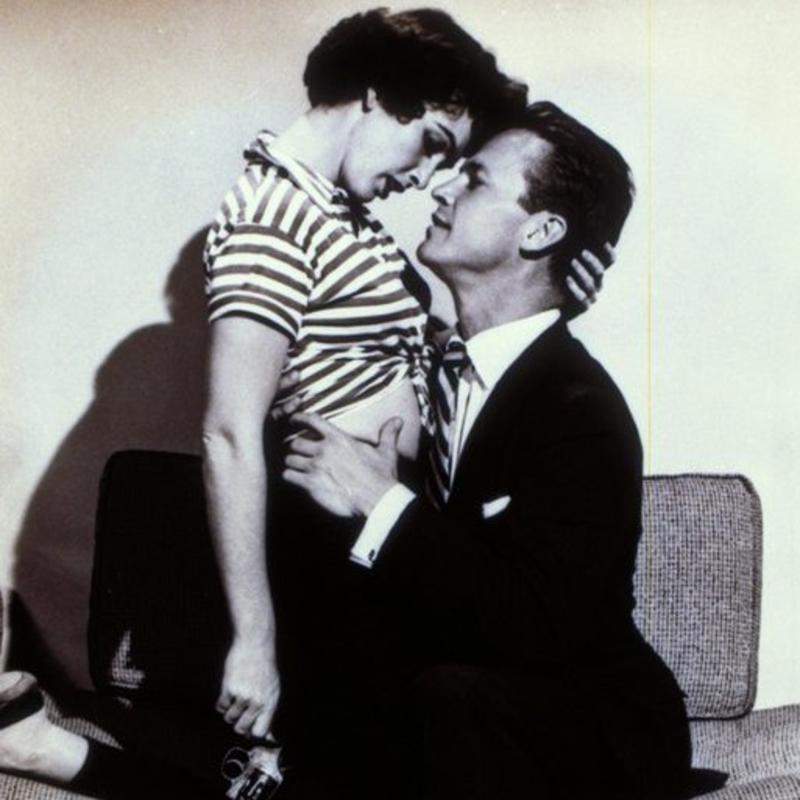
Conception of Main Character and Couple
- The opening concludes that Hammer could not protect Christina
- Unidentified hoods force his car off the road - capturing both
- Christina tortured to death, but a faked car accident fails to kill Hammer and he wakes in a hospital
- The FBI questions him in the guise of the 'Interstate Crime Commission'
- In novel - it is a conversation between equals and serves only to establish some facts about the dead girl before Hammer starts his mission of revenge
- Aldrich's version is radically different - it expresses the alienation of the two sides from each other.
- Hammer stares away from the investigators as they describe him, starting with his name and moving on to his profession
- Investigators make his profession, a Divorce detective, indistinguishable from a seamy blackmail racket, with Hammer seducing the wives, and his secretary and girlfriend Velda (Maxine Cooper) acting as bait for the errant husbands
- A simple attack on Hammer may have thrown its weight behind this account of him - but we are not asked to identify with the FBI
- The scene suggests that their professed contempt is tinged with envy -
- Hammer and Velda are being attacked precisely because they have found a financially rewarding way of exploiting their sexuality without doing anything that is literally illegal
- Behind the censure lie the tensions widely observed in the America of the period, the envy of the individual entrepreneur that was felt by those swallowed up by the relentless expansion of corporations inside and outside Government
- The feeling of those whose success depends on the repression of their sexuality towards the couple who use sexuality to create their success
- Hostility of the FBI also contrasts with local cop Pat Chambers (Wesley Addy)
- Two scenes with Hammer which frame the interrogation scene, and underlined by the fact that Pat refuses the FBI's invitation to join in the questioning
- Quality of Meeker's delivery of Hammer's final line to the FBI - 'All right, you've got me convinced, I'm a real stinker' - makes clear that this is not so much his admission of moral corruption as a piece of weary sarcasm
Attitude Towards Hammer and Velda
pg 242
- Refined in a later scene, when he finally returns to his apartment
- Two sets specifically made for this film: Hammer's apartment and Velda's apartment
- His apartment speak of modernity, of precise order and of money
- A piece of Hammer's fast car and his neat suits and ties, the place of a man who has exploited new technologies successfully for gain
- One of its most prominent features is a reel-to-reel tape recorder built into the wall as an answering machine
- The technology of audio tape, first commercially exploited in the late 'forties' is central to the divorce business; later, we gather that Velda's role has involved he making of 'incriminating' tapes
- When Velda arrives, the ensuing scene is an amalgam of different kinds of work and pleasure
- We see the couple's sexual interest in each other, Hammer's desire to investigate Christina's death, and the ongoing detail of the divorce business
- Overall effect of the scene is one of frustration and anxiety, their lovemaking locked both by the sense that Velda's seductiveness needs to be put to work on her latest 'Mr Friendly' and y the consciousness that Christina's death has inserted Hammer into a mysterious and possibly dangerous world
Attitude Towards Couple Summed Up
- Reservations are clear
- The sordid side to the divorce business, of which Velda is painfully aware - unsurprisingly, given the greater odium heaped on women in these areas
- the cockiness of Hammer, prepared to brush this aside in the light of the money and success it has brought
- More subtle is the sense of stagnation, of the pair trapped in the endless round of the business - it is significant that part of he conversation in the apartment scene is about a piece of seduction that is having to be done over again.
- but these reservations operate against he fact that as the young, attractive couple at the center of this narrative, the roles that they occupy
- boss and secretary
- heterosexual lovers
- strong man and beautiful woman
Hammer's Motivation Understood
- Unlike the figure in Spillane's novel, he is not interested in vengeance, but rather by power
- He reasons to Pat that when a girl's death 'rings bells all the way to Washington,' whatever is behind it must be 'something big'
- His desire to find the treasure that he assumes Christina to have been protecting is that most American fantasy, of fabulous riches, something that will change his and Velda's life entirely
Abilities in Question
- Velda's exit line in the apartment scene is 'Stay away from the window - somebody might blow you a kiss'
- Neatly juxtaposes her anxiety that Hammer may be on a death list wish the awareness behind her irony that, given Hammer's specific field of expertise, he is possibly more used to having kisses aimed at him than bullets
Answered?
- Next sequence appears to answer this, engaging with the question of the kind of power that the film noir private eye needs to posses
- Night falls, and Hammer leaves his apartment to follow the first of the leads that will hopefully take him to his prize - as he walks the street, he is followed by a small-time hood
- In outline, this has the quality of a moment familiar in the genre; the experience of the private eye is to be expressed by the fact that he invariably knows when he is being tailed, and so can turn on his pursuer and dispatch him back to his bosses with a message that he is not a man to be trifled with
- Add a little violence, and this is exactly how the scene appears in Spillane's novel
Landscape of the Street
- Aldrich represents the landscape of the street as a series of screens and frames
- Opaque windows
- A mirror
- The bars of a news-stand outlining a figure
- The moment of conflict:
- Hammer watches his assailant's reflection in the mirror on a cigarette machine
- Turns and blind him with popcorn thrown into his face
- As they fight, the position of the knife makes a visual point about phallic power:
- Hammer emerges as stronger, smarter, even more of a man than his opponent
- The scene doesn't end with the hood being sent away
- Hammer beats the head of the man viciously against a wall
- He slumps to the ground but recovers and attacks Hammer again
- It now emerges that the fight is effectively taking place at the edge of a precipice, as the hood is sent hurling down a long, steep set of steps
Interest of Hammers Excess of Dominance
- The interest is not just Hammer's dominance, now routine, but the degree to which the frustrations of the earlier scene with Velda are resolved by the release of massive physical violence
- The crucial contrast is between the ease with which satisfactions seem to flow from the exercising of physical violence and the visceral pleasures of speed, compared with the relative frustrations associated with the exercise of sexuality
- It might sound as if I am describing the situation of the Robert Stack character in Douglas Sirk's Written on the Wind (Clip), made in the following year
- There are many connections, but both the role of the high performance car as a finally unsatisfying form of access to pleasure and the use of the staircase as a central part of the mise-en-scene are obvious links
The Good Detective
pg 243
- Follows his one lead, obtains the address of Christina's apartment
- At the apartment, a kindness to the porter earns him another lead
- The new address of Christina's flatmate, Lily Carver (Gaby Rodgers)
- Lily claims to be frightened of the men who came for Christina, and in a later scene, Hammer rescues her and takes her back to his apartment
- These actions conform in part with how we believe a good detective should act
- Familiar virtues
- Sympathy for the little guy, which commonly earns the private eye information usually denied to others
- The rescue of the threatened woman linked with the control of sexuality
- His refusal to let Lily seduce him
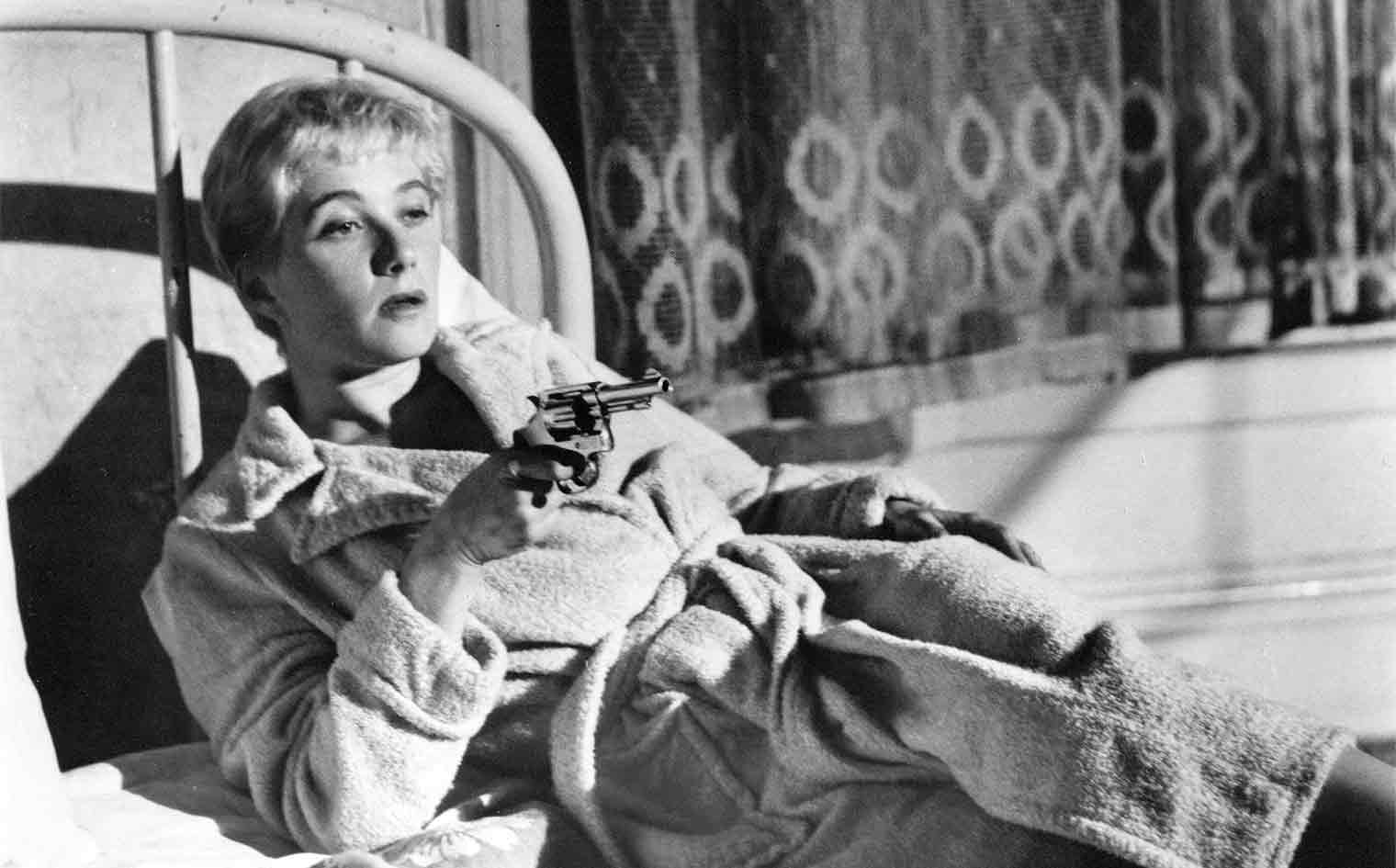
Still: The treacherous woman - Lily Carver (Gaby Rodgers) threatens Hammer
The Ill-equipped Detective
- Hammer is ill-equipped for his detective role
- What is perhaps the most clearly lacking in him is sympathy for and relation to the past
- Narrative in film noir is often a disinterring and ordering of information buried in the past
- It is clear that Hammer is a man with no understanding of or response to a world which relates to earlier times
- He knows that he should be able to read the clues buried in the past, but is unable to do so, or even to determine if there are hidden meaning at all
- This produces a series of anxious gestures
- He never heard of Christina Rossetti before encountering Christina Bailey, but removes the book of poems from Christina's bedside when he visits the apartment
- Same scene - he notices the Tchaikovsky which is playing on her radio
- At his apartment he tunes into same radio station in a baffled attempt to gain some access to the dead girl
- His visits to his various leads are similar, all pictured in sets that speak of the old city, in contrast to his own modern apartment block
- An exemplary case is the sequence in the room of the opera singer Carmen Trivaco (Fortunio Bonanove)
- Trivaco is playing a recording of Caruso singing Flotow's Martha
- Hammer moves around the set, poking in the clutter with which Aldrich has filled it, threateningly breaking a record, well aware that he has no apparatus for understanding such material
In Context of Modern Technology
end of pg 243 and 244
- We may compare this to his competence in the context of modern technologies
- When Hammer is offered a bribe in the form of a new car, his unwary mechanic friend Nick (Nick Dennis) is about to kill himself by starting the engine
- Hammer instantly locates one booby trap and is accurate in his guess that there will be another one of a different kind, one associated with pleasure, which would have exploded on the highway, 'when you open her up wide'
- The reference to sexual pleasure her is obvious, and can be put in context by considering the figure of Nick
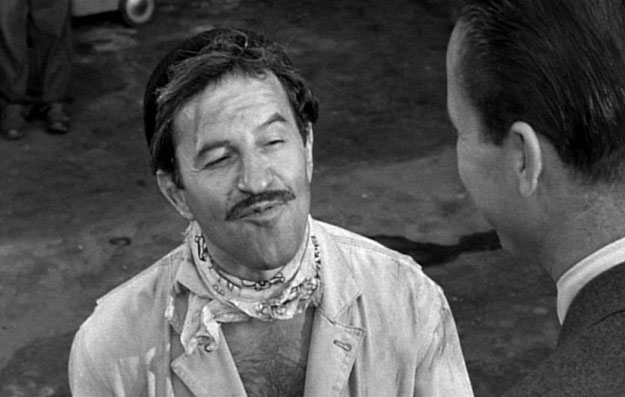
Nick
- Nick is the only character in the narrative who does not appear in Spillane's novel hints at the importance of Nick
- He could be said to represent the kinds of energy and pleasure that the novel gives directly to Hammer
- Aldrich links this brio with Hammer indirectly and implies that pleasures are perhaps entirely satisfying only when assigned to the world of the imagination
- They exist in Nick not as action but as catch phrases.
- His memorable 'Va-Va-Voom' and 'Pretty-Pow!' represent the energy of sex and speed free from the confusions and anxieties of status and progress that haunt Hammer,
- We never see Nick driving a fast car and never see him with a girl
Narrow Range of Competence
- Earlier, Aldrich has cut from Hammer's success in locating the bombs in the car to his first visit to Velda's apartment
- The he plots pursuit of something big, telling Velda that they are giving up the 'penny-ante divorce business' for a while
- Her research has dug up some more names, but two of these are the names of men who died in 'accidents' like the one that nearly killed Hammer
- Her anxiety is clear, but Hammer, at his most cocky and least attractive, remains impervious to it
- He goes off to interrogate the leads, even visiting the head of the hoods, Carl Evello (Paul Stewart), in his mansion
- Here, Hammer firmly puts off the blonde who offers herself to him and paralyses the hood sent to dispatch him with a trick that reduces the man to unconsciousness in seconds
- In this context, and for a moment, the private eye still appears to have powers that approximate to magic
- But Aldrich emphasizes the narrowness of his range
- His competence extends only to blondes and hoods
Distance from Spillane's World
- When Hammer finds out that Nick has been killed, Aldrich again makes a cut which takes Hammer from the garage to Velda's apartment
- The shocked reaction to Nick's death is another mark of the distance from the world of Spillane, where death is commonplace, and the death of the good simply stokes the fires of revenge
- We may assume that the divorce business does not generally result in bodies
- The scene makes clear that this hero is not one who routinely deals with death
Central Scene
End of pg 244 and beginning of pg 245
- I take this scene to be central to Kiss Me, Deadly, and it is difficult to discuss it adequately in a short space
- We see the couple first in an erotic encounter, as Hammer wakes Velda in her bedroom
- For a moment, they kiss - then, as Hammer gives her the news, the eroticism seeps away and we see repetition of an earlier device
- A series of shots in which a couple talk without being able to look at each other in the face (Spade's Existential Speech)
- Velda offers a scathing critique of the whole undertaking, and her fear and anger touches on the central question: is the object of the search worth dying for?
- Hammer's 'something Big' now becomes Velda's contemptuous 'the great Whatsit', suggestive of trickery or illusion, and the enemy becomes 'the nameless ones'
- The point here is her recognition that they are caught up in something very different from the world of divorce cases or even of ordinary police work, and the difference is not simply one of scale
- As Hammer's name for the prize implies
Complications and Desire for Vengeance
- Nor is it the case that the old behavior becomes heroic in this new situation - it is simply dangerous
- As the scene develops, Velda tells Hammer of another man related to the case and asks if he wants her to seduce this man
- Maxine Cooper makes Velda's depression and self-disgust here delicately evident
- Hammer abstractedly replies that he wants revenge on those who killed Nick
- Velda finally turns on him in utter scorn:
'You want to avenge the death of you dear friend. How touching. How sweet. How nicely it justifies you quest for the great Whatsit. [pauses]... Why don't you leave, Mike?
- Even after this, she makes an appointment to meet him again later
- The insight that Hammer is trapped in his role that will very possibly destroy them coexists for Velda with recognition of her own dependence
Realization
- Hammer visits a nightclub where he hears 'Rather Have the Blues' again
- Chance reference to Christina's death leads to the realization that the one essential clue is the note that she asked the petrol station attendant to post
- This in turn leads, via an interlude in which he again bests Evello's thugs, to the morgue, where the doctor (Percy Helton) has extracted a key from Christina's body
- The desire to reach the prize now becomes increasingly hysterical
- Hammer tries to bribe
- The attacks the doctor
- He repeats the process with the desk clerk in charge of the lockers where the prize in kept
- We now learn that it is a box of fissionable material, in effect, a very small atom bomb
Drugs to A-Bomb
- In the Spillane's novel, the object of the search was a large quantity of drugs
- There was apparently a straightforward reason for moving away from this
- In his interview with Truffaut, Aldrich raised the problem of censorship, that 'up to The Man With the Golden Arm, drugs couldn't be mentioned in American films'
- This seems likely; the change in Samuel Fuller's Pick-up on South Street (1953) from Dwight Taylor's original story, which had dealt with drug traffic rather than spying, may have been similarly motivated.
- In Kiss Me, Deadly the effect of the change to atomic material is pervasive
- Aldrich said that 'once we made that decisions, everything fell into place'
- The bomb exists as both a confirmation and an explanation of the view that Velda expressed in her criticism of Hammer, a rationale for the fact that the age in which they are living is beginning to make the hero, whose prowess is founded on the 'fights and the kissing scenes,' an anachronism
- The bomb itself is a whatsit of massive destructive capacity and no solid, exchangeable matter
- What we finally see consists cinematically of almost contentless white light and sound
- Similarly, the change from drugs to bomb entails the move from the named ones (the Mafia of the novel) to Velda's 'nameless ones'
- Behind the traditional thugs like Evello where the private eye's prowess, or magic, still works is the figure of Doctor Soberin (Albert Dekker), an ambiguously scientist and spy, for whom Hammer is just an irrelevant nuisance
Soberin's Downfall
pg 246
- Soberin is defeated in this film, but not by the hero
- It emerges that Lily Carver's role as Christina's dead flatmate was a masquerade
- In fact, she is Soberin's girl, the exact equivalent of Velda, given the task of attempting to seduce Hammer in order to find out what he knows
- Now she too turns on her man, demanding half of what is in the sealed box that contains the bomb
- Soberin's indifference to Lily is marked by his self-absorbed game of trying to characterize the bomb through learned references:
- Pandora's Box
- Lot's Wife
- The Head of Medusa
- Lily's reply is, 'Never mind about the evil, what's in it?'
- He tells her that he is leaving her, adding almost in the same sentence that she is creasing his overcoat by carelessly sitting on it
- Unsurprisingly, she shoots him
- Although it is certainly clear that whatever the box contains is deadly, she now embraces her own death by opening it fully
- The ensuing explosion destroys everything, but a gesture to the benign couple remains on some prints
- Hammer has arrived at the house to rescue the abducted Velda
- They stand watching the holocaust in the final shot
The Womanly Connection
- To understand Kiss Me, Deadly, it is necessary to connect:
- The woman who opens the film and dies at the beginning of it
- The one who closes it by dying at the end
- To link both to Velda
- An important part of my pleasure in this film is the performances of these three actors, and an important part of its coherence is the argument that links them together
- Christina's initial criticism, that men are absorbed in their own physicality and the status reflected in their possessions and money, become Velda's awareness that Hammer's vision of his powers is positively dangerous
- The subject concludes with Lily's murderous response to Soberin's abandonment of her, a response which, suggestively, he completely fails ta anticipate
- What these three women have in common is their frustration in the face of the self-absorbed, indifferent men
- The choice faced by he hero between the 'good' and the 'bad' woman common in film noir falls away here, where in every case the eroicised woman is now isolated by male unresponsiveness
Similarities to Written on the Wind
- Elements in Written on the Wind present a parallel context
- There is male anxiety about expressing sexual need is diverted into both a forward and a backward movement
- A reliance on the thrills of new technologies and a nostalgia for an age dependent on simpler physical prowess
- In he Sirk, at least one half of this movement is interpreted positively
- The pioneer values and the country world offering a fragment of the past as benign
- In Kiss Me, Deadly the neetive past
- Represented as a high culture that is becoming progressively incomprehensible and a city of dark spaces
- It is the women in Aldrich's film
- two of them will die horribly
